


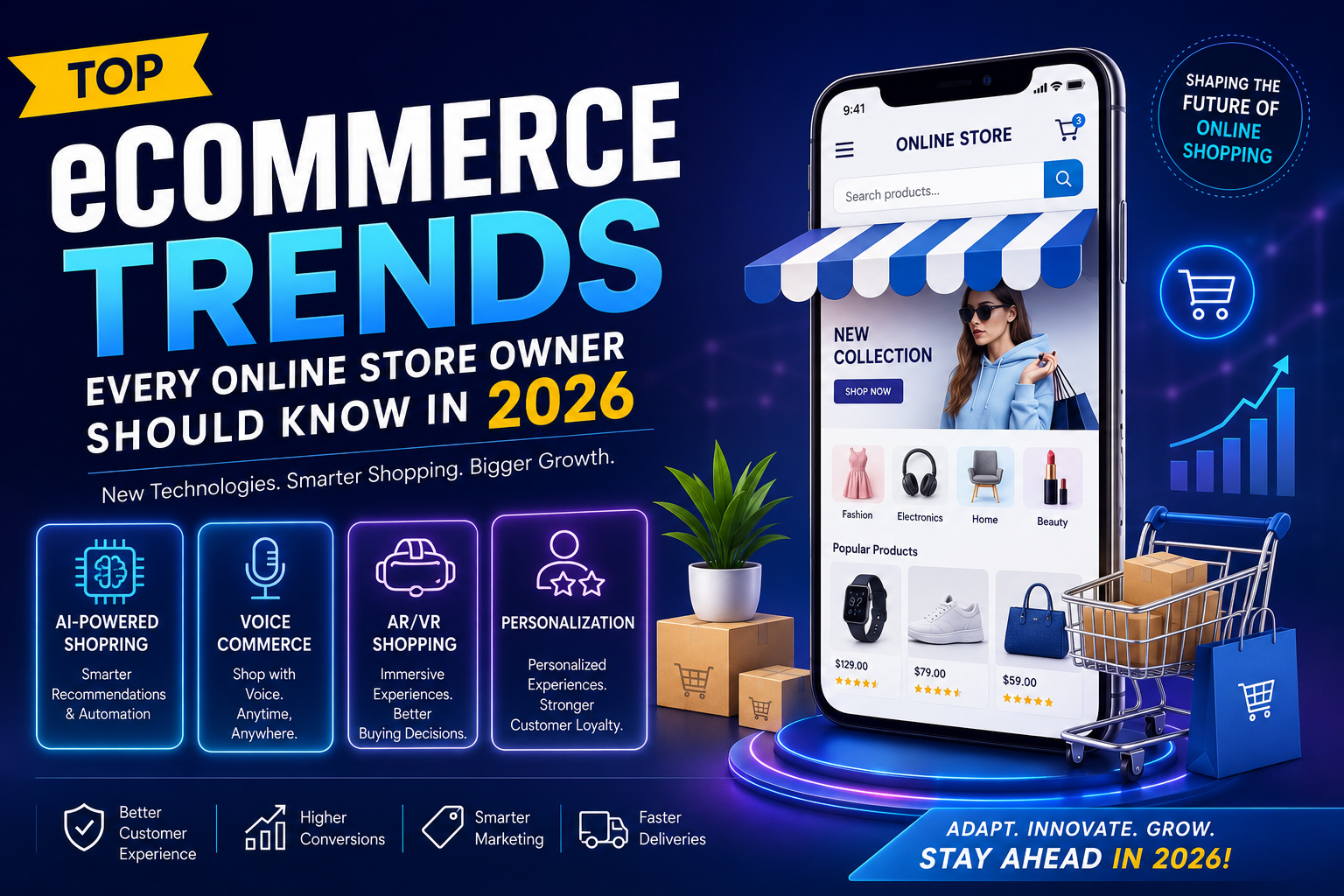
The eCommerce industry is evolving faster than ever. Changing customer expectations, emerging technologies, and increasing online competition are forcing businesses to continuously adapt and innovate. The strategies that helped online stores succeed a few years ago may no longer be enough in 2026.
Modern consumers expect more than just an online storefront. They demand personalized shopping experiences, instant customer support, faster delivery, seamless payments, and interactive product experiences that closely replicate in-store shopping.
Technologies such as Artificial Intelligence (AI), Voice Commerce, Augmented Reality (AR), Virtual Reality (VR), advanced personalization, automation, and data-driven marketing are transforming the way customers discover, evaluate, and purchase products online.
For online store owners, keeping up with these trends is no longer optional—it is essential for increasing conversions, improving customer loyalty, and staying ahead of competitors.
In this comprehensive guide, we explore the top eCommerce trends that will define the future of online shopping in 2026 and explain how businesses can leverage them for growth.
- AI-Powered Shopping: The Future of Smart eCommerce
Artificial Intelligence has become one of the biggest innovations in the eCommerce industry. In 2026, AI is no longer just a technology for large enterprises; it is accessible to businesses of all sizes.
AI helps online stores understand customer behavior, automate tasks, and provide highly personalized shopping experiences.
How AI is Transforming Online Shopping
AI-Based Product Recommendations
One of the most common applications of AI is intelligent product recommendation.
AI analyzes:
- Browsing history
- Previous purchases
- Customer preferences
- Search behavior
- Shopping patterns
Based on this information, AI suggests products that customers are more likely to purchase.
Examples:
- “Customers also bought”
- “Recommended for you”
- “You may also like”
These recommendations increase average order value and improve customer satisfaction.
AI Chatbots and Virtual Assistants
Customers expect immediate answers before making purchasing decisions.
AI-powered chatbots can provide:
- 24/7 customer support
- Product recommendations
- Order tracking assistance
- FAQ responses
- Personalized shopping advice
Unlike traditional customer support, AI chatbots can handle thousands of customer interactions simultaneously.
Benefits include:
- Reduced support costs
- Faster response times
- Improved customer experience
AI-Generated Content
AI is also changing how eCommerce stores create content.
Businesses can use AI to generate:
- Product descriptions
- Marketing emails
- Ad copies
- SEO content
- Social media captions
This improves productivity and helps businesses scale their content strategy.
AI-Powered Inventory Management
Managing inventory efficiently is a major challenge for online stores.
AI can analyze sales trends and predict demand, helping businesses:
- Avoid stock shortages
- Reduce overstocking
- Improve supply chain planning
Benefits of AI in eCommerce
- Better customer experiences
- Increased conversion rates
- Higher average order values
- Improved marketing performance
- Reduced operational costs
- Smarter business decisions
- Voice Commerce: Shopping Through Voice Assistants
Voice technology is changing how consumers search for information and make purchases.
Voice commerce allows customers to browse products, compare prices, and place orders using voice commands.
Popular voice assistants include:
- Amazon Alexa
- Google Assistant
- Apple Siri
As smart speakers and mobile voice assistants become more common, voice shopping is expected to become a major eCommerce channel.
How Voice Commerce Works
A customer might say:
- “Order my favorite coffee again.”
- “Find the best wireless headphones under $100.”
- “Buy a black running shoe in size 9.”
The voice assistant searches available products and helps complete the purchase.
Why Voice Commerce Matters
Faster Shopping Experience
Voice commands reduce the need for typing and navigation.
Greater Convenience
Customers can shop while:
- Cooking
- Driving
- Working
- Performing other activities
Increased Accessibility
Voice shopping helps people with physical limitations interact with online stores more easily.
How to Optimize Your Store for Voice Search
Use Conversational Keywords
Voice searches are more natural.
Instead of:
“Best laptop”
Users may say:
“What is the best laptop for graphic design under $1000?”
Optimize content for long-tail, conversational keywords.
Create FAQ Content
FAQ pages naturally match voice search queries.
Examples:
- What is the best smartphone for photography?
- Which laptop is best for gaming?
- How long does shipping take?
Improve Website Speed
Fast websites improve both traditional SEO and voice search performance.
- AR Shopping: Bringing Products into the Customer’s World
One of the biggest disadvantages of online shopping is that customers cannot physically touch or test products.
Augmented Reality (AR) solves this problem by allowing customers to visualize products in their real-world environment using smartphones or tablets.
Examples of AR in eCommerce
Furniture and Home Decor
Customers can place virtual furniture inside their homes to check:
- Size
- Color
- Style compatibility
Fashion and Accessories
AR enables virtual try-on experiences for:
- Glasses
- Jewelry
- Clothing
- Shoes
Beauty Products
Customers can test:
- Lipstick shades
- Makeup styles
- Hair colors
before making a purchase.
Benefits of AR Shopping
Reduces Purchase Uncertainty
Customers gain confidence before buying.
Lowers Return Rates
Better product visualization leads to better purchase decisions.
Increases Engagement
Interactive experiences keep users on the website longer.
Improves Conversion Rates
Customers are more likely to purchase when they understand how products will look.
- VR Shopping: Creating Immersive Virtual Stores
While AR enhances the real world, Virtual Reality (VR) creates a completely digital shopping environment.
VR allows customers to enter a virtual store, explore products, and interact with items as if they were shopping in a physical location.
Examples of VR Commerce
Customers can:
- Walk through virtual showrooms
- Explore digital stores
- View products from every angle
- Experience products before purchasing
Industries That Benefit from VR
Fashion
Virtual fashion stores and digital fitting rooms.
Real Estate
Virtual property tours.
Automotive
Virtual vehicle showrooms.
Luxury Products
Premium digital experiences.
Advantages of VR Shopping
- Immersive customer experiences
- Better product understanding
- Higher customer engagement
- Increased brand differentiation
Although VR adoption is still growing, forward-thinking brands are already investing in virtual shopping experiences.
- Hyper-Personalization Using Customer Data
Generic shopping experiences are becoming outdated.
In 2026, customers expect online stores to understand their needs and preferences.
Personalization uses data and AI to create unique experiences for each customer.
Types of eCommerce Personalization
Personalized Product Recommendations
Products based on:
- Purchase history
- Browsing behavior
- Interests
Personalized Email Marketing
Instead of sending the same email to everyone, businesses can create targeted campaigns based on customer behavior.
Examples:
- Cart abandonment emails
- Product recommendations
- Birthday discounts
- Special offers
Personalized Website Content
Different customers can see:
- Different homepage banners
- Personalized offers
- Relevant products
Benefits of Personalization
- Higher conversion rates
- Better customer loyalty
- Increased average order value
- Improved customer satisfaction
Customers are more likely to buy from brands that understand their preferences.
- Social Commerce Continues to Grow
Social media platforms are no longer just marketing channels; they have become shopping destinations.
Platforms like:
- TikTok
allow users to discover and purchase products without leaving the app.
Benefits of Social Commerce
Shorter Buying Journey
Customers can move from discovery to purchase quickly.
Better Product Discovery
Algorithms show relevant products to users.
Influencer-Driven Sales
Influencers build trust and encourage purchases.
- Mobile Commerce Will Dominate Online Sales
Mobile shopping continues to grow every year.
Customers expect a smooth mobile experience.
Mobile Optimization Best Practices
- Responsive website design
- Fast loading pages
- Easy navigation
- Mobile wallets
- Simple checkout process
A poor mobile experience can result in high cart abandonment rates.
- Faster and More Flexible Payment Methods
Payment convenience plays a major role in conversion rates.
Customers expect multiple payment options.
Popular methods include:
- Credit and debit cards
- Digital wallets
- Buy Now Pay Later (BNPL)
- One-click checkout
- Contactless payments
Why Payment Flexibility Matters
It helps:
- Reduce cart abandonment
- Improve customer trust
- Increase international sales
- Sustainable eCommerce Practices
Modern consumers are becoming more environmentally conscious.
Brands adopting sustainable practices can gain customer trust.
Examples include:
- Eco-friendly packaging
- Carbon-neutral shipping
- Sustainable products
- Ethical sourcing
- Automation and Data-Driven Decision Making
Successful eCommerce businesses use automation to improve efficiency.
Automation can handle:
- Email marketing
- Customer segmentation
- Inventory updates
- Order processing
- Customer support
Data analytics helps businesses understand:
- Customer behavior
- Sales trends
- Marketing performance
Businesses that use data effectively make smarter decisions.
How Online Store Owners Can Prepare for the Future
To remain competitive in 2026, businesses should:
Invest in Modern Technology
Adopt AI tools, automation, and advanced customer experiences.
Focus on Customer Experience
Make shopping fast, simple, and enjoyable.
Prioritize Mobile Optimization
Ensure your store performs perfectly on all devices.
Use Data for Better Decisions
Track customer behavior and continuously optimize your strategy.
Stay Flexible
The eCommerce industry changes rapidly. Businesses that adapt quickly will gain a competitive advantage.
How Alphabet Developers LLP Can Help Your eCommerce Business Prepare for 2026
Adopting the latest eCommerce technologies requires technical expertise and the right development strategy.
At Alphabet Developers LLP, we help businesses build modern, high-performance online stores designed for the future.
Our eCommerce services include:
- Shopify Development
- Magento & Adobe Commerce Development
- WooCommerce Development
- Custom eCommerce Solutions
- AI Integration
- Payment Gateway Integration
- Performance Optimization
- Mobile Optimization
- SEO-Friendly Development
- Maintenance and Technical Support
Why Choose Alphabet Developers LLP?
Future-Ready Solutions
We build scalable stores using modern technologies and industry best practices.
Performance-Focused Development
Fast-loading and optimized websites that improve user experience and conversions.
Custom Development
Every business has unique requirements, and we create solutions tailored to your goals.
Long-Term Support
From development to maintenance and upgrades, we help your business grow continuously.
Conclusion
The future of eCommerce in 2026 is driven by technology, convenience, and personalization.
AI-powered shopping, voice commerce, AR/VR experiences, social commerce, mobile optimization, flexible payments, and automation are changing the way consumers interact with online stores.
Businesses that embrace these trends early will deliver better customer experiences, increase conversions, and build stronger relationships with their customers.
The key to long-term eCommerce success is not simply selling products online—it is creating intelligent, personalized, and engaging shopping experiences.
If you are looking to upgrade your online store with the latest technologies, Alphabet Developers LLP can help you build a future-ready eCommerce solution designed for growth and success.


