


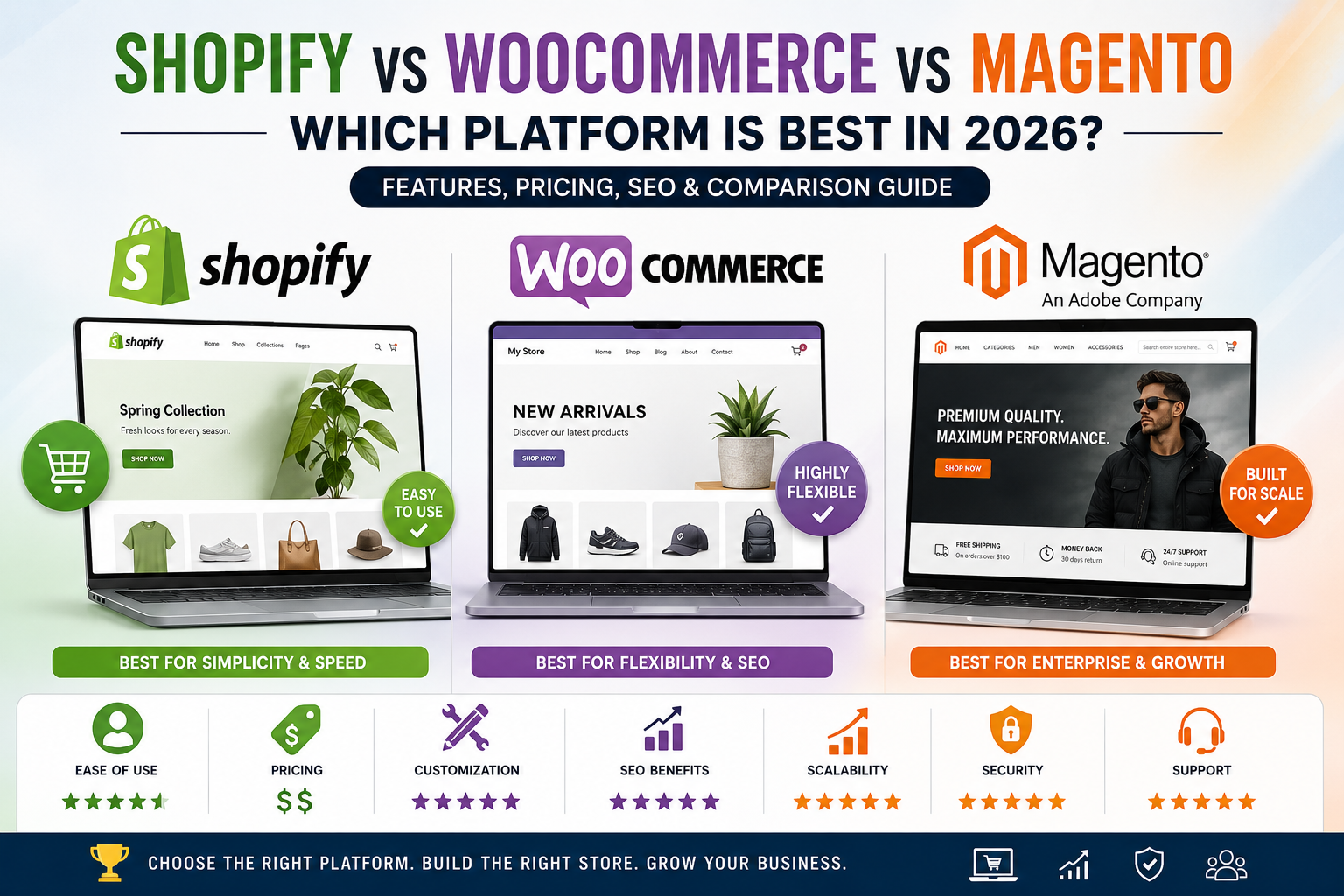
Choosing the right eCommerce platform is one of the most important decisions for any online business. Your platform affects everything from website performance and design flexibility to SEO, scalability, security, and long-term business growth.
In 2026, the three most popular eCommerce platforms dominating the market are Shopify, WooCommerce, and Magento (Adobe Commerce). Each platform has its own strengths, limitations, pricing structure, and ideal use cases.
While Shopify is known for its simplicity and quick setup, WooCommerce offers flexibility and affordability through WordPress, and Magento provides enterprise-level customization and scalability for large businesses.
The question is:
Which platform is best for your business in 2026?
The answer depends on your budget, technical requirements, business size, customization needs, and future growth plans.
This complete comparison guide will analyze Shopify, WooCommerce, and Magento based on pricing, features, ease of use, customization, SEO, performance, security, scalability, and maintenance so that you can make an informed decision.
Overview of Shopify, WooCommerce & Magento
What is Shopify?
Shopify is a fully hosted Software-as-a-Service (SaaS) eCommerce platform that allows businesses to create online stores without worrying about hosting, security, or technical maintenance.
It provides everything required to start selling online, including hosting, themes, payment gateways, and an easy-to-use admin panel.
Best For:
- Beginners
- Small businesses
- Startups
- Businesses that want quick launch
Main Advantages:
- Easy setup
- Managed hosting
- Strong security
- 24/7 support
What is WooCommerce?
WooCommerce is a free open-source eCommerce plugin built for WordPress. It converts a WordPress website into a fully functional online store.
It is one of the most popular choices because of its affordability, flexibility, and large ecosystem of plugins and themes.
Best For:
- Small to medium businesses
- Content-focused websites
- Businesses wanting more control
Main Advantages:
- Low starting cost
- Thousands of plugins
- Excellent blogging capabilities
- Full ownership of data
What is Magento (Adobe Commerce)?
Magento is a powerful open-source eCommerce platform designed for businesses requiring advanced features, high scalability, and complete customization.
It is commonly used by medium and large businesses with complex requirements.
Best For:
- Growing brands
- Large online stores
- B2B businesses
- Enterprise companies
Main Advantages:
- Unlimited customization
- Multi-store management
- Advanced product management
- Enterprise-level scalability
Shopify vs WooCommerce vs Magento: Quick Comparison Table
| Feature | Shopify | WooCommerce | Magento |
| Ease of Use | ⭐⭐⭐⭐⭐ Excellent | ⭐⭐⭐⭐ Good | ⭐⭐⭐ Advanced |
| Setup Time | Very Fast | Moderate | Longer |
| Hosting | Included | Separate | Separate |
| Customization | Good | Excellent | Excellent |
| SEO Capabilities | Very Good | Excellent | Excellent |
| Scalability | High | Medium to High | Enterprise Level |
| Security | Managed | Self-managed | Self-managed |
| Performance | Excellent | Depends on Hosting | Excellent with Proper Setup |
| Multi-store Support | Limited | Possible with Plugins | Native Support |
| B2B Features | Limited | Plugin-Based | Excellent |
| Best For | Startups | SMBs | Large Enterprises |
Shopify vs WooCommerce vs Magento Pricing Comparison
Shopify Pricing
Shopify follows a subscription-based pricing model.
Typical costs include:
- Monthly subscription fees
- Premium themes
- Paid applications
- Transaction fees
Estimated Cost:
- Basic Store: $39–$100/month
- Growing Store: $100–$500/month
- Enterprise (Shopify Plus): $2,000+/month
Pros:
- Predictable costs
- Hosting included
- No server management
Cons:
- Monthly recurring charges
- App costs can increase expenses
- Limited control over the platform
WooCommerce Pricing
WooCommerce itself is free, but you need to pay for hosting and additional services.
Typical expenses:
- Domain name
- Web hosting
- Premium themes
- Plugins
- Maintenance
Estimated Cost:
- Small Store: $100–$500/year
- Medium Store: $500–$3,000/year
- Large Store: $3,000+/year
Pros:
- Low initial investment
- Flexible budget options
- No monthly platform fees
Cons:
- Maintenance responsibility
- Plugin compatibility issues
- Performance depends on hosting
Magento Pricing
Magento Open Source is free to download, while Adobe Commerce has licensing fees.
Costs include:
- Development
- Hosting
- Extensions
- Maintenance
Estimated Cost:
- Small Magento Store: $5,000–$15,000
- Medium Store: $15,000–$50,000
- Enterprise Store: $50,000–$200,000+
Pros:
- Highly scalable
- Unlimited customization
- Suitable for complex stores
Cons:
- Higher development costs
- Requires experienced developers
- More technical maintenance
Ease of Use Comparison
Shopify: The Easiest Option
Shopify is designed for non-technical users.
You can:
- Choose a theme
- Add products
- Configure payments
- Start selling quickly
No coding knowledge is required.
WooCommerce: Moderate Learning Curve
WooCommerce is user-friendly for people familiar with WordPress.
However, you need to manage:
- Hosting
- Security
- Plugin updates
- Backups
Some technical knowledge is helpful.
Magento: For Advanced Businesses
Magento offers incredible flexibility but requires technical expertise.
Tasks like:
- Server configuration
- Performance optimization
- Custom development
usually require professional developers.
Design & Customization
Shopify
Shopify provides professional themes and a simple drag-and-drop editor.
However, deep customization can be limited compared to open-source platforms.
Rating: 4/5
WooCommerce
WooCommerce provides thousands of themes and plugins.
Because it is open source, developers can modify almost every part of the website.
Rating: 5/5
Magento
Magento provides the highest level of customization.
Businesses can create completely custom:
- User experiences
- Checkout processes
- Product configurations
- B2B workflows
Rating: 5/5
SEO Comparison: Which Platform Ranks Better?
SEO is crucial for generating organic traffic and reducing dependency on paid advertising.
Shopify SEO
Shopify provides:
- Clean URLs
- SSL certificates
- Mobile-friendly themes
- Basic SEO controls
Limitations:
- Less flexibility in URL structure
- Some advanced SEO customizations are limited
Rating: 4/5
WooCommerce SEO
WooCommerce is built on WordPress, making it one of the strongest platforms for content marketing.
Advantages:
- Full control over URLs
- Advanced SEO plugins
- Excellent blogging capabilities
Rating: 5/5
Magento SEO
Magento offers powerful technical SEO features.
Advantages:
- Custom URLs
- Meta tag management
- XML sitemaps
- Schema support
- Advanced product SEO
Rating: 5/5
Performance & Speed
Shopify
Shopify provides optimized hosting and a global infrastructure.
Advantages:
- Fast loading speeds
- CDN support
- Automatic optimization
Rating: 5/5
WooCommerce
Performance depends on:
- Hosting quality
- Theme optimization
- Plugin usage
Rating: 4/5
Magento
Magento can deliver excellent performance but requires powerful hosting and proper optimization.
Rating: 5/5
Security Comparison
Shopify
Shopify handles:
- SSL certificates
- Security patches
- PCI compliance
Rating: 5/5
WooCommerce
Security depends on the store owner.
You must manage:
- Updates
- Backups
- Security plugins
Rating: 4/5
Magento
Magento provides strong security but requires regular maintenance and updates.
Rating: 5/5
Scalability & Business Growth
Shopify
Suitable for growing brands but has limitations for highly customized enterprise needs.
Good for:
Small to large businesses.
WooCommerce
Can scale significantly with proper hosting and optimization.
Good for:
Small to medium-large businesses.
Magento
Designed for businesses expecting high traffic, large catalogs, and complex workflows.
Good for:
Large enterprises and B2B businesses.
Pros & Cons Summary
Shopify Pros
- Easy to use
- Fast setup
- Excellent support
- Secure hosting
Shopify Cons
- Monthly costs
- App dependency
- Limited customization
WooCommerce Pros
- Affordable
- Highly flexible
- Excellent SEO
- Strong content management
WooCommerce Cons
- Requires maintenance
- Hosting management
- Plugin conflicts can occur
Magento Pros
- Unlimited customization
- Enterprise scalability
- Powerful catalog management
- Advanced B2B features
Magento Cons
- Higher cost
- Requires technical expertise
- Longer development time
Which Platform Should You Choose in 2026?
Choose Shopify If:
You want a simple, fast, and hassle-free solution.
Ideal for:
- New businesses
- Small stores
- Entrepreneurs with limited technical knowledge
Choose WooCommerce If:
You want flexibility, strong SEO, and affordable costs.
Ideal for:
- Bloggers
- Content-driven websites
- Small and medium businesses
Choose Magento If:
You need advanced features and long-term scalability.
Ideal for:
- Large catalogs
- B2B stores
- Multi-store businesses
- Enterprise brands
How Alphabet Developers LLP Can Help You Build the Perfect eCommerce Store
Selecting the right eCommerce platform is only the first step. The success of your online business depends on proper development, optimization, security, and ongoing support.
At Alphabet Developers LLP, we specialize in creating high-performing eCommerce solutions tailored to your business requirements.
Our eCommerce Development Services
We provide:
- Shopify Store Development
- WooCommerce Development
- Magento & Adobe Commerce Development
- Custom Theme Development
- Extension & Plugin Development
- Payment Gateway Integration
- Store Migration Services
- Performance Optimization
- SEO-Friendly Development
- Maintenance & Support
Why Choose Alphabet Developers LLP?
Experienced Development Team
Our developers have expertise in building scalable eCommerce websites across multiple industries.
Customized Solutions
We understand that every business is different. We create solutions tailored to your products, customers, and growth plans.
Performance-Focused Development
We build fast, secure, and mobile-friendly stores designed to maximize conversions.
Long-Term Partnership
From initial planning to post-launch support, our team remains committed to helping your business succeed.
Final Verdict: Shopify vs WooCommerce vs Magento
There is no single “best” eCommerce platform for everyone.
- Shopify is best for simplicity and quick launch.
- WooCommerce is best for affordability, flexibility, and SEO.
- Magento is best for enterprise-level customization and scalability.
The right choice depends on your business goals, budget, technical requirements, and future growth strategy.
Before choosing a platform, consider not only your current needs but also where your business will be in the next five years.
If you are planning to build, migrate, or upgrade an eCommerce store, Alphabet Developers LLP can help you choose the right platform and develop a powerful online store that drives traffic, conversions, and revenue.
Contact our team today and transform your eCommerce vision into a successful digital business.


