
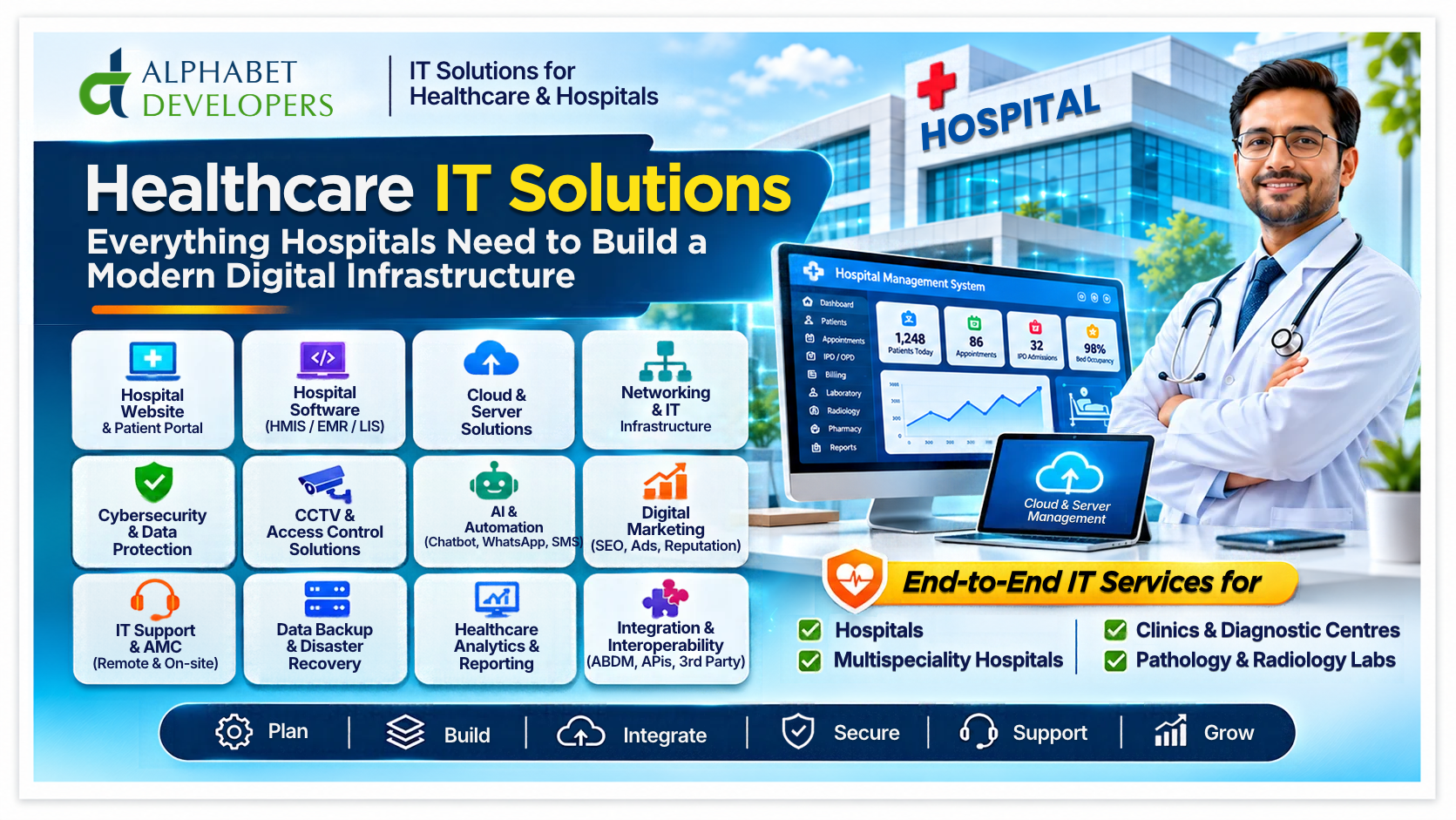
The healthcare industry is undergoing a major digital transformation. Hospitals, multispeciality healthcare centres, clinics and diagnostic laboratories increasingly depend on technology to manage daily operations, improve patient experiences, streamline administration and protect sensitive information.
From patient registration and appointment scheduling to billing, medical records, diagnostic reports and hospital administration, technology plays an important role in almost every department of a modern healthcare facility.
However, managing multiple technology systems can become challenging. Hospitals may have separate software for billing, pathology, radiology, pharmacy, patient records and accounting. Their computers, servers, networks, security systems and websites may also be managed by different vendors. Without proper IT planning and integration, these systems can become difficult to maintain and may create unnecessary operational complications.
This is where a professional IT solutions provider can make a difference.
Alphabet Developers LLP helps healthcare organisations plan, develop, implement and maintain their digital infrastructure through a broad range of IT and technology services. From hospital website development and software integration to cloud hosting, networking, server management, cybersecurity and ongoing IT support, hospitals can work with a technology partner to manage their IT requirements more effectively.
In this guide, we explore the major IT solutions and services that hospitals need to build a modern, connected, secure and scalable digital infrastructure.
- IT Infrastructure Planning and Technology Consulting
Every hospital has different technology requirements. A small clinic may need a few computers, reliable internet connectivity and appointment management software, while a large multispeciality hospital may require dedicated servers, extensive networking, integrated hospital software and advanced security systems.
The first step should be understanding the hospital’s existing infrastructure and future requirements.
A professional IT agency can provide:
- IT infrastructure assessment and consultation.
- Hospital technology planning and budgeting.
- Hardware and software requirement analysis.
- IT architecture and implementation planning.
- Technology vendor selection and coordination.
- IT procurement assistance.
- Existing system evaluation and modernization.
- IT asset inventory and lifecycle planning.
- Digital transformation consulting.
A proper IT assessment helps hospital management identify outdated equipment, disconnected applications, network limitations and security weaknesses.
Based on this assessment, an IT roadmap can be created for implementing new technology without unnecessarily disrupting hospital operations.
- Computer Hardware and IT Equipment Solutions
Computers and IT equipment are essential for hospital departments. Reception desks, billing counters, doctors’ chambers, laboratories, pharmacies, administrative offices and medical records departments all depend on reliable devices.
An IT solutions provider can help hospitals select, procure, install and maintain suitable equipment.
Typical services include:
- Desktop and workstation supply and installation.
- Laptop procurement and configuration.
- Computer upgrades and hardware replacement.
- Printers, scanners and multifunction devices.
- Barcode and QR code scanners.
- Receipt and label printers.
- Server and storage hardware.
- Network switches, routers and firewalls.
- UPS and backup power solutions for IT equipment.
- IT equipment troubleshooting and maintenance.
Different departments may require different hardware configurations. For example, diagnostic imaging departments may need high-performance workstations, while reception areas may require reliable computers with suitable printing and scanning facilities.
An IT partner can help standardize equipment, maintain inventory and coordinate replacements to reduce unnecessary downtime.
- Hospital Networking and Connectivity Solutions
A reliable network is one of the foundations of a modern hospital. Multiple departments need to communicate with central systems and access shared information.
A properly designed network can connect reception, doctors’ chambers, nursing stations, laboratories, pharmacies, billing departments, administrative offices and other authorized locations.
Hospital networking services can include:
LAN and WAN Setup: Design and implementation of wired networks across hospital departments and buildings.
Wi-Fi Infrastructure: Secure wireless connectivity for authorized staff, hospital devices and designated guest areas.
Router and Switch Configuration: Network equipment installation, configuration and management.
Structured Cabling: Network cabling, patch panels, racks and cable management.
Network Segmentation: Separating administrative, clinical, guest and other network traffic where appropriate.
VPN Configuration: Secure remote connectivity for authorized users and support teams.
Internet Connectivity Management: Primary and backup internet connections, router failover and network troubleshooting.
Network Monitoring: Monitoring connectivity, device availability and network performance.
Hospitals should avoid placing all devices on one unrestricted network. Segmentation and access controls help reduce the impact of compromised devices and limit unnecessary access between departments.
- Hospital Management Software (HMS/HMIS)
Hospital Management Software, also known as Hospital Management Information System (HMIS), helps healthcare facilities manage administrative and operational activities through a centralised platform.
Depending on the software, modules can include:
- Patient registration and management.
- OPD appointment scheduling.
- IPD admission and discharge management.
- Doctor and department management.
- Bed and ward management.
- Patient billing and invoicing.
- Pharmacy and inventory management.
- Laboratory management.
- Radiology workflows.
- Insurance and TPA coordination.
- Staff and resource management.
- Financial and operational reports.
A hospital may choose an established HMS product, implement an available solution through an authorized vendor or commission custom software for specific requirements.
An IT agency can assist with software evaluation, implementation planning, configuration, data migration, integrations, user access and technical support.
The selection should consider the hospital’s size, clinical workflows, existing applications, reporting needs and long-term requirements.
- Electronic Medical Records and Digital Patient Records
Electronic Medical Records (EMR) and Electronic Health Records (EHR) help healthcare organizations manage patient information digitally.
Depending on the platform and implementation, these systems may support patient history, diagnoses, clinical notes, prescriptions, allergies, treatment information and diagnostic reports.
IT services in this area may include:
- EMR/EHR software implementation.
- Digital patient record management.
- Patient history and document management.
- Clinical workflow configuration.
- Role-based access controls.
- Digital document storage.
- Integration with existing HMIS platforms.
- Data migration and system support.
It is important to distinguish between software implementation and clinical decision-making. Medical professionals remain responsible for clinical documentation, diagnosis, prescriptions and treatment decisions.
Where systems exchange health information, interoperability and authorized access must be planned carefully.
- Laboratory Information Management and Diagnostic Integration
Pathology laboratories and diagnostic departments generate significant amounts of information every day.
A Laboratory Information System (LIS) can help manage test registration, sample tracking, processing workflows, report generation and laboratory operations.
Radiology Information Systems (RIS) and Picture Archiving and Communication Systems (PACS) can support imaging workflows and the storage and retrieval of medical images.
An IT solutions provider can assist with:
- LIS implementation and configuration.
- Diagnostic centre software integration.
- Laboratory report portals.
- Patient report delivery workflows.
- RIS and PACS connectivity planning.
- Integration between diagnostic systems and HMIS.
- Secure access to reports and medical documents.
- Data backup and storage planning.
Where medical devices or laboratory equipment need to communicate with software, integration must be planned with the equipment manufacturer and specialist vendors. Clinical validation, equipment calibration and biomedical engineering responsibilities should remain with qualified providers.
- Hospital Website Development and Digital Presence
A professional website is an important communication and patient-enquiry channel for modern hospitals.
Patients and their families frequently search online for hospital locations, available specialties, doctors, appointment information, facilities and contact details.
Alphabet Developers can help hospitals build responsive and professional websites that present essential information clearly.
Hospital website development services can include:
- Custom hospital website design and development.
- Multispecialty hospital websites.
- Doctor and consultant profile management.
- Department and specialty pages.
- Treatment and service information pages.
- Online appointment enquiry forms.
- Contact and location pages.
- Careers and recruitment sections.
- Patient information and FAQ sections.
- Blog and healthcare content management.
- Website hosting, maintenance and security.
- Website speed and performance optimization.
A hospital website should also be mobile-friendly, accessible and easy to navigate.
Online appointment requests and enquiries should be directed to authorized hospital staff through secure workflows. Patient information should not be unnecessarily exposed through public forms or unprotected email communications.
- Mobile Applications and Patient Portals
Mobile applications and patient portals can make healthcare services more accessible and convenient.
Depending on the hospital’s requirements, a custom mobile app or portal may provide:
- Online appointment requests.
- Doctor and specialty information.
- Appointment reminders.
- Access to authorized diagnostic reports.
- Digital payment functionality.
- Hospital announcements.
- Patient support requests.
- Secure document access.
- Follow-up appointment information.
An IT agency can design and develop mobile applications using appropriate technologies, integrate them with supported hospital systems and provide ongoing technical maintenance.
Access to medical records must be protected through proper authentication, authorization, consent and secure data transmission.
For hospitals that do not need a full mobile application, a responsive patient portal or website-based booking system may be a more practical starting point.
- Cloud Hosting, Servers and Data Centre Solutions
Hospitals need reliable computing infrastructure to support their applications, databases, websites and internal systems.
Depending on their requirements, they may use on-premises servers, cloud infrastructure, dedicated servers or hybrid environments.
Alphabet Developers can assist with hosting and server-related services, including:
- Linux VPS setup and configuration.
- Dedicated server deployment.
- Cloud infrastructure planning.
- Server migration and modernization.
- Web server configuration using Nginx or Apache.
- Database server configuration.
- Storage planning.
- Domain, DNS and SSL management.
- Server monitoring and maintenance.
- Resource optimization and capacity planning.
Cloud infrastructure can provide flexibility, but hospitals must evaluate data sensitivity, access controls, service availability, backup arrangements, contracts and applicable data protection requirements before selecting a provider.
The right solution depends on application requirements, expected workloads, recovery objectives and the hospital’s IT policies.
- Cybersecurity and Healthcare Data Protection
Security is one of the most important parts of hospital IT infrastructure.
Hospitals manage sensitive information, including patient details, appointments, medical records, diagnostic reports, employee information and financial transactions.
A cyber incident can interrupt hospital operations, affect access to important information and create serious privacy concerns.
An IT agency can help strengthen security through:
Firewall Configuration: Restricting unauthorized network access and controlling traffic.
Endpoint Protection: Deploying and managing appropriate antivirus and endpoint security solutions.
Server Hardening: Securing Linux and Windows servers, services, permissions and administrative access.
Website Security: Identifying outdated software, vulnerable plugins, application weaknesses and malware.
Access Management: Implementing user roles, access restrictions and multi-factor authentication.
Security Audits: Reviewing website, application, server and network configurations.
Vulnerability Management: Identifying weaknesses and coordinating appropriate updates and remediation.
Security Monitoring: Reviewing relevant system logs, alerts and suspicious activities.
Incident Response Support: Helping investigate compromised systems, contain threats and restore clean services.
India’s Digital Personal Data Protection Act, 2023 and the DPDP Rules, 2025 establish requirements concerning the handling of digital personal data. The framework covers matters such as lawful processing, consent and transparency, security safeguards and accountability. Its implementation has a phased timeline, so hospitals should assess applicable obligations with qualified legal and privacy professionals.
CERT-In’s directions also specify, for covered entities and notified incident categories, cyber incident reporting within six hours of noticing an incident and secure retention of ICT system logs for a rolling period of 180 days. Hospitals should establish incident procedures and determine their applicable responsibilities rather than assuming a general website security service is sufficient.
An IT agency can support technical safeguards, documentation and incident readiness, but it should not claim to provide legal certification or guarantee regulatory compliance unless appropriately authorized.
- Data Backup, Storage and Disaster Recovery
Hospitals depend on access to information for many operational activities. Data loss caused by hardware failure, ransomware, accidental deletion or software problems can create significant disruption.
A reliable backup and recovery strategy should be part of the hospital’s IT plan.
Services can include:
- Automated database backups.
- Website and application backups.
- Server image backups.
- Secure cloud backup configuration.
- Backup encryption and access controls.
- Off-site backup storage.
- Backup monitoring and reporting.
- Disaster recovery planning.
- Data restoration testing.
- Business continuity planning.
Hospitals should define Recovery Time Objectives (RTO) and Recovery Point Objectives (RPO) according to the importance of their systems.
For example, the recovery requirements for a patient registration platform may differ from those of a public informational website.
A backup is useful only when it can be restored successfully. Periodic restoration tests are therefore essential.
- CCTV, Access Control and Biometric Systems
Physical security is another important element of hospital infrastructure.
Hospitals may require CCTV cameras, controlled entry points, staff attendance systems and monitoring solutions across different premises.
An IT solutions provider can help plan, procure, deploy or coordinate specialist installations for:
- IP CCTV camera systems.
- Network Video Recorders (NVRs).
- CCTV storage and monitoring.
- Biometric attendance systems.
- RFID-based access systems.
- Door access control.
- Visitor management systems.
- Network connectivity for security devices.
- Centralized monitoring solutions.
These systems should be configured with appropriate access restrictions, secure credentials and suitable retention policies.
Privacy, patient confidentiality and applicable requirements for camera placement and surveillance must also be considered.
- Hospital Communication and Collaboration Systems
Hospitals need reliable communication between departments, healthcare professionals, administration, patients and external service providers.
Communication technology can include:
- Professional hospital email systems.
- Domain-based email setup.
- Email hosting and administration.
- IP telephony and VoIP.
- Intercom and internal communication systems.
- Call center and enquiry management.
- SMS notification integration.
- WhatsApp Business integration.
- Appointment reminder workflows.
- Staff collaboration platforms.
- Video conferencing systems.
These services can help improve communication and reduce manual follow-ups.
Automated messages should be carefully designed to avoid disclosing sensitive patient information to unauthorized recipients.
- Healthcare Automation, APIs and AI Solutions
Automation can reduce repetitive administrative work and improve coordination between hospital systems.
Examples of useful automation include appointment confirmations, enquiry assignment, internal notifications, report-ready alerts and follow-up reminders.
Custom IT development can also connect different platforms through APIs.
Potential solutions include:
- Patient enquiry automation.
- Website chatbots for general information.
- WhatsApp Business workflow integration.
- Appointment notification systems.
- CRM integration.
- Automated administrative reports.
- API integration between compatible software systems.
- Data synchronization between applications.
- Management dashboards.
- AI-assisted administrative workflows.
AI tools can help with administrative tasks, information retrieval and customer support, but clinical diagnosis and treatment recommendations require appropriate clinical validation, governance and specialist oversight.
Hospitals should not use general-purpose chatbots as substitutes for qualified medical professionals.
- Healthcare Analytics and Business Intelligence
Hospital management needs accurate information to understand operational performance and plan resources.
Business intelligence solutions can consolidate information from authorized systems and present it through dashboards and reports.
Possible reporting areas include:
- Patient registration and enquiry trends.
- OPD and IPD activity.
- Appointment volumes.
- Department utilization.
- Bed occupancy information.
- Billing and revenue reports.
- Inventory and stock levels.
- Diagnostic turnaround times.
- Website traffic and digital enquiries.
- Administrative performance indicators.
An IT agency can develop dashboards and reporting tools that work with approved data sources.
Reports should use appropriate data permissions and avoid exposing patient-level information to users who do not need access to it.
- Healthcare Digital Marketing and Online Reputation Management
A modern hospital also needs a strong digital presence to make its services discoverable to patients.
Digital marketing is not a replacement for clinical quality, but it can help hospitals communicate their facilities, specialties and services to the public.
Alphabet Developers can support hospital marketing through:
- Healthcare website SEO.
- Local SEO and Google Business Profile management.
- Google Ads campaign management.
- Social media marketing.
- Healthcare content marketing.
- Doctor and specialty profile promotion.
- Website conversion optimization.
- Online reputation management.
- Analytics and campaign reporting.
Medical content should be accurate, responsible and reviewed by qualified healthcare professionals where it makes clinical claims. Marketing practices must also follow applicable advertising and professional conduct rules.
- IT Helpdesk, Annual Maintenance and Outsourced IT Support
Installing IT systems is only the beginning. Hospitals need ongoing technical support to keep equipment, applications and networks functioning reliably.
An IT agency can provide ongoing support through a defined maintenance or managed IT services agreement.
This can include:
- Remote IT helpdesk support.
- On-site technical assistance where contracted.
- Computer and printer troubleshooting.
- Network maintenance.
- Server administration.
- Software update assistance.
- User account management.
- IT asset tracking.
- Preventive maintenance.
- Vendor coordination.
- Incident management.
- IT documentation and reporting.
- Annual Maintenance Contracts (AMC).
A hospital can choose between scheduled support, remote assistance, on-site visits or a combination based on its operational needs.
Service Level Agreements should clearly define support hours, response targets, escalation procedures, responsibilities and exclusions.
- ABDM Integration and Digital Healthcare Interoperability
India’s digital healthcare ecosystem is developing through the Ayushman Bharat Digital Mission (ABDM).
ABDM provides digital health infrastructure intended to support the exchange of health information through interoperable systems and patient consent.
Relevant components include:
- ABHA for digital health identity.
- Health Facility Registry (HFR).
- Healthcare Professionals Registry (HPR).
- Health Information Exchange and Consent Manager (HIE-CM).
- ABDM-enabled Hospital Management Information Systems.
The Unified Health Interface (UHI), launched in June 2026, provides an open network approach intended to connect patients and healthcare providers across compatible digital platforms.
Hospitals may need assistance evaluating their existing software, identifying compatible solutions and planning integrations. ABDM integration can involve sandbox registration, implementation milestones, functional testing, security assessment and production approval, depending on the solution and participation pathway.
Alphabet Developers can assist with technical assessment, software integration planning and coordination with eligible ABDM-enabled solution providers. Production integration and certification must follow the applicable National Health Authority processes.
More information is available through the official Ayushman Bharat Digital Mission website.
- How Alphabet Developers LLP Can Become Your Hospital’s Complete IT Partner
Managing multiple technology vendors can create complexity for hospital management. One company may manage the website, another may maintain the server, while separate vendors handle networking, software and security.
Alphabet Developers LLP aims to help hospitals simplify their technology requirements through coordinated IT and digital solutions.
Our service approach can cover the following areas:
IT Consultation and Infrastructure Planning: Assessment of existing systems, technology planning and infrastructure recommendations.
Website and Application Development: Hospital websites, patient portals, custom web applications and mobile applications.
Software Implementation and Integration: Technical assistance with HMS, CRM, appointment systems and other compatible healthcare software.
Server and Cloud Management: Linux VPS, dedicated servers, cloud infrastructure, hosting, migration and maintenance.
Network and Security Solutions: Network planning, firewall configuration, access controls and cybersecurity improvements.
Digital Healthcare Solutions: Appointment workflows, communication automation, APIs and administrative digital tools.
Backup and Disaster Recovery: Backup configuration, storage planning, restoration testing and recovery support.
IT Support and AMC: Helpdesk support, server maintenance, troubleshooting and vendor coordination.
Digital Marketing: Healthcare SEO, social media, Google Ads, content marketing and online reputation management.
Our approach can be tailored to the size and operational requirements of each healthcare organization. Depending on the project, Alphabet Developers can deliver software and digital services directly or coordinate with specialist hardware, networking, clinical software and equipment vendors.
This distinction is important: clinical systems, medical devices, statutory approvals and specialist biomedical services require appropriate domain expertise and qualified partners.
- Building a Future-Ready IT Infrastructure for Your Hospital
A hospital should not implement technology simply because it is available. Every investment should address a genuine operational requirement, improve reliability or support a better patient experience.
A practical implementation roadmap can follow these stages:
- IT Assessment: Review current hardware, software, networks, hosting and security.
- Requirement Planning: Identify hospital departments, workflows and future technology needs.
- Infrastructure Setup: Establish the required servers, connectivity, devices and security controls.
- Software Implementation: Deploy or integrate suitable hospital applications.
- Data and System Integration: Connect compatible systems using secure and approved methods.
- Testing and Training: Validate workflows and train authorized hospital staff.
- Maintenance and Monitoring: Establish support responsibilities, backups and update schedules.
- Continuous Improvement: Review performance, security and changing operational requirements.
A phased approach helps hospitals manage costs, reduce implementation risks and avoid unnecessary disruption.
Conclusion
Digital infrastructure is now an essential part of modern hospital operations. From hospital management software and networking to cloud servers, cybersecurity, digital patient services and IT support, every technology component contributes to the overall efficiency and reliability of a healthcare organization.
However, managing these systems requires proper planning, technical expertise and ongoing maintenance. Hospitals need technology solutions that work together, protect sensitive information and support their long-term operational goals.
Alphabet Developers LLP offers a broad range of IT, software development, infrastructure, cybersecurity and digital marketing services to support hospitals, clinics, diagnostic centres and other healthcare organizations.
Whether you are establishing a new hospital, upgrading existing IT infrastructure, implementing digital applications or looking for an outsourced IT support partner, we can help assess your requirements and plan suitable technology solutions.
Looking for Complete IT Solutions for Your Hospital?
Partner with Alphabet Developers LLP to strengthen your hospital’s digital infrastructure through professional IT services, software solutions, server management, cybersecurity, automation and ongoing technical support.
Website: https://www.alphabetinfo.com/
Alphabet Developers LLP – Your Technology Partner for Modern Healthcare.
Official References and Further Reading
- Ayushman Bharat Digital Mission – National Health Authority
- Unified Health Interface – Ministry of Health and Family Welfare
- Digital Personal Data Protection Rules, 2025 – Government of India
- CERT-In Cyber Security Directions, 2022
- National Medical Commission – HMIS and ABDM Integration Guidance


