


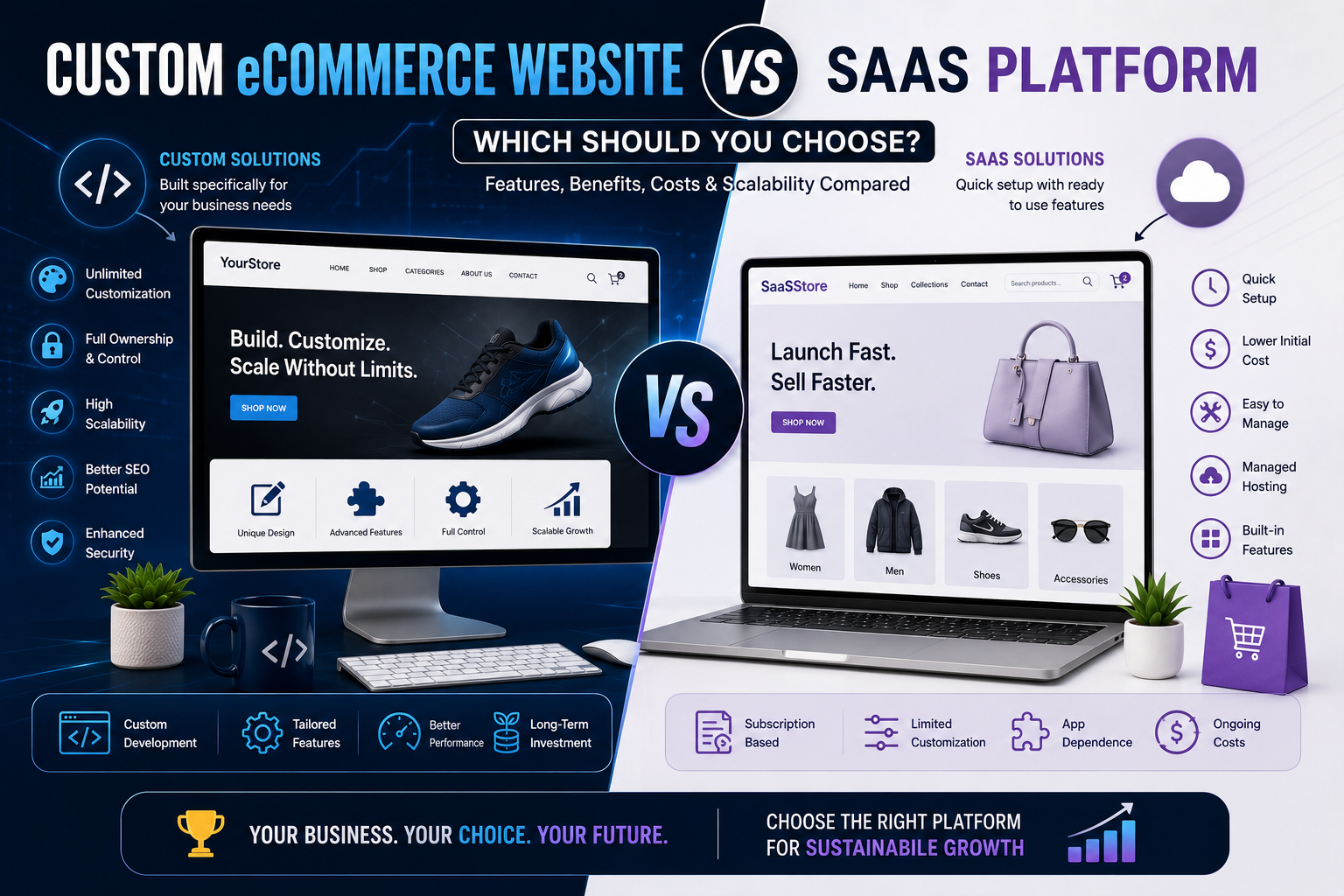
The eCommerce industry has experienced massive growth over the past decade. Today, businesses of all sizes—from startups and small retailers to large enterprises—are moving online to reach customers worldwide.
However, one of the biggest decisions every business owner faces before launching an online store is choosing the right eCommerce platform.
Should you invest in a fully customized eCommerce website tailored specifically to your business needs, or should you choose a SaaS (Software as a Service) platform that allows you to launch quickly with ready-made tools?
Popular SaaS platforms such as Shopify, BigCommerce, and Wix eCommerce have made it easier than ever to start selling online. At the same time, custom eCommerce solutions built using technologies like Magento, WooCommerce, Laravel, React, or other frameworks provide unlimited flexibility and complete ownership.
Both approaches have advantages and disadvantages. The right choice depends on your business goals, budget, technical requirements, growth strategy, and long-term vision.
In this complete guide, we compare custom eCommerce websites and SaaS platforms based on cost, customization, scalability, SEO, security, performance, maintenance, and business growth to help you make the right decision in 2026.
What is a Custom eCommerce Website?
A custom eCommerce website is an online store developed specifically according to your business requirements. Unlike pre-built platforms, a custom solution gives you complete control over the website’s functionality, design, user experience, and integrations.
Custom stores can be developed using:
- Magento (Adobe Commerce)
- WooCommerce
- Laravel
- React.js
- Next.js
- Headless Commerce architecture
- Custom APIs and frameworks
A custom eCommerce solution is designed around your business rather than forcing your business to adapt to platform limitations.
What is a SaaS eCommerce Platform?
SaaS (Software as a Service) eCommerce platforms are ready-to-use solutions where the provider manages the infrastructure, hosting, security, and software updates.
Examples include:
- Shopify
- BigCommerce
- Wix eCommerce
- Squarespace Commerce
With SaaS platforms, businesses pay a monthly or yearly subscription fee and use the available tools, themes, and applications to build their online store.
These platforms are popular because they require minimal technical knowledge and offer faster deployment.
Custom eCommerce vs SaaS: Quick Comparison Table
| Feature | Custom eCommerce Website | SaaS Platform |
| Initial Cost | Higher | Lower |
| Monthly Cost | Flexible | Recurring subscription |
| Design Freedom | Unlimited | Limited by themes |
| Custom Features | Fully customizable | Limited by platform |
| Ownership | Complete ownership | Platform dependent |
| SEO Control | Complete control | Good but limited |
| Scalability | Excellent | Good to high |
| Performance Optimization | Full control | Limited control |
| Security Management | Your responsibility | Managed by provider |
| Development Time | Longer | Faster |
| Technical Knowledge | Required | Minimal |
| Third-party Integration | Unlimited | Depends on available apps |
- Cost Comparison
SaaS Platform Costs
One of the biggest advantages of SaaS platforms is the lower initial investment.
Typical expenses include:
- Monthly subscription fees
- Premium themes
- Paid applications
- Transaction fees
- Custom development (if required)
For example:
- Basic stores: $30–$100/month
- Growing stores: $100–$500/month
- Enterprise plans: $2,000+/month
Advantages
- Low upfront cost
- Predictable monthly expenses
- No hosting management
Disadvantages
Over time, subscription fees, app costs, and transaction charges can become expensive.
Custom eCommerce Website Costs
Custom websites generally require a larger initial investment.
Costs may include:
- Design and development
- Hosting infrastructure
- Third-party integrations
- Testing and quality assurance
- Maintenance
Estimated costs:
- Small custom store: $5,000–$15,000
- Medium business store: $15,000–$50,000
- Enterprise solution: $50,000+
Advantages
- No platform limitations
- Better long-term flexibility
- Ownership of your system
- Customization and Flexibility
Customization is where custom eCommerce solutions outperform SaaS platforms.
SaaS Platforms
SaaS platforms provide:
- Pre-designed themes
- App marketplaces
- Basic customization tools
However, businesses may face limitations when they require:
- Unique checkout flows
- Advanced pricing models
- Custom product configurators
- Complex business workflows
Custom eCommerce
Custom solutions allow you to build exactly what your business needs.
Examples include:
- Custom product builders
- Marketplace functionality
- Subscription systems
- Advanced loyalty programs
- Personalized customer journeys
- Complex B2B features
There are virtually no restrictions.
- Design and User Experience
Your website design directly impacts customer trust and conversion rates.
SaaS Design
Most SaaS platforms offer professional themes that allow quick store creation.
Advantages:
- Faster launch
- Lower cost
- Modern templates
Limitations:
- Similar designs used by competitors
- Limited UI customization
Custom Design
A custom eCommerce website provides:
- Unique brand identity
- Personalized customer experience
- Custom user journeys
- Conversion-focused interfaces
Brands looking to differentiate themselves often prefer custom development.
- Scalability and Business Growth
Your platform should support future growth.
SaaS Scalability
SaaS platforms can handle thousands of products and significant traffic.
They are suitable for:
- Startups
- Small businesses
- Growing brands
However, highly complex enterprise requirements may require custom solutions.
Custom Scalability
Custom solutions are built to scale according to your needs.
They can support:
- Millions of products
- Multiple websites
- Multiple currencies
- International markets
- Complex customer groups
- Enterprise integrations
For rapidly growing businesses, custom development provides greater flexibility.
- SEO Capabilities
SEO is essential for driving organic traffic.
SEO in SaaS Platforms
Modern SaaS platforms offer:
- Basic meta management
- Mobile optimization
- SSL security
- XML sitemaps
However, some technical SEO controls may be restricted.
SEO in Custom eCommerce Websites
Custom solutions offer complete SEO flexibility.
You can control:
- URL structures
- Schema markup
- Page speed optimization
- Technical SEO improvements
- Custom metadata
- Server-level optimizations
This makes custom websites ideal for businesses that heavily depend on organic search.
- Performance and Website Speed
Website speed directly impacts user experience and conversions.
SaaS Performance
Advantages:
- Managed hosting
- Optimized infrastructure
- CDN support
Limitations:
- Limited server-level optimization
Custom Performance
Custom websites allow complete control over:
- Hosting environment
- Caching strategies
- Database optimization
- Frontend performance
A properly developed custom website can achieve exceptional performance.
- Security and Maintenance
Security is critical for online businesses.
SaaS Security
The provider manages:
- Software updates
- Server security
- SSL certificates
- Compliance requirements
This reduces technical responsibilities.
Custom Security
With a custom website, you have more responsibility.
You need to manage:
- Security updates
- Server monitoring
- Backups
- Vulnerability testing
Professional development teams can ensure enterprise-level security.
- Third-Party Integrations
Modern eCommerce stores depend on multiple tools.
Examples include:
- Payment gateways
- Shipping providers
- ERP systems
- CRM software
- Marketing tools
SaaS Integrations
Most SaaS platforms provide app marketplaces.
Advantages:
- Easy installation
- Faster setup
Limitations:
- Limited functionality
- Monthly app fees
Custom Integrations
Custom websites allow direct integration with almost any software through APIs.
This is especially useful for businesses with complex workflows.
- Ownership and Control
This is one of the biggest differences.
SaaS Platforms
You do not fully own the platform.
You operate under the provider’s:
- Rules
- Pricing structure
- Feature availability
- Technical limitations
Custom eCommerce Websites
You have complete ownership over:
- Code
- Features
- Data
- Hosting choices
- Future development
This provides maximum independence.
- Time to Launch
SaaS
A SaaS store can be launched within:
- A few days
- A few weeks
Ideal for businesses that want to enter the market quickly.
Custom Development
A custom website may require:
- Several weeks
- Several months
depending on complexity.
The longer development time results in a more tailored solution.
Custom eCommerce vs SaaS: Pros & Cons Summary
SaaS Platform Pros
- Lower initial investment
- Faster launch
- No technical maintenance
- Managed security
- Easy for beginners
SaaS Platform Cons
- Monthly recurring costs
- Limited customization
- Dependency on the provider
- Additional app expenses
Custom eCommerce Pros
- Unlimited flexibility
- Unique design
- Complete ownership
- Better advanced SEO control
- Custom integrations
- Long-term scalability
Custom eCommerce Cons
- Higher initial cost
- Longer development time
- Requires technical support
Which Option is Best for Different Business Types?
Startups and Small Businesses
Recommended: SaaS platforms
Because they offer:
- Quick setup
- Lower costs
- Easy management
Growing Brands
Recommended: Depends on requirements
A SaaS platform can work initially, but businesses requiring custom experiences may benefit from custom development.
Enterprise Businesses
Recommended: Custom eCommerce solutions
Because they require:
- Complex workflows
- Advanced integrations
- Scalability
- Complete control
How Alphabet Developers LLP Can Help You Choose the Right eCommerce Solution
Selecting the right eCommerce platform is not just about technology. It is about choosing a solution that aligns with your business goals, customer expectations, and future growth plans.
At Alphabet Developers LLP, we help businesses design, develop, and optimize powerful eCommerce websites tailored to their needs.
Our eCommerce Development Services
We offer:
- Custom eCommerce Website Development
- Shopify Store Development
- Magento & Adobe Commerce Development
- WooCommerce Development
- Headless Commerce Solutions
- Custom API Development
- Payment Gateway Integration
- ERP & CRM Integration
- Performance Optimization
- Security Enhancements
- Ongoing Maintenance & Support
Why Choose Alphabet Developers LLP?
Experienced eCommerce Developers
Our in-house team has experience building eCommerce solutions for startups, SMEs, and enterprise businesses.
Business-Focused Development
We do not simply build websites—we create digital commerce solutions designed to increase conversions and support long-term growth.
Scalable Architecture
Our solutions are built with future expansion in mind.
Transparent Communication
We maintain clear communication, project transparency, and dedicated support throughout the development process.
Final Verdict: Custom eCommerce Website or SaaS Platform?
There is no one-size-fits-all answer.
Choose a SaaS platform if:
- You need a fast launch
- You have a limited budget
- You prefer a simple management experience
Choose a custom eCommerce website if:
- You require advanced functionality
- You need unique customer experiences
- You want complete ownership and flexibility
- You plan significant long-term growth
The best decision depends on your business objectives, technical requirements, and future roadmap.
At Alphabet Developers LLP, we help businesses evaluate their needs and build the ideal eCommerce solution—whether it is a fast SaaS-based store or a fully customized enterprise platform.
Ready to build your next online store? Contact Alphabet Developers LLP today and let our eCommerce experts turn your vision into a high-performing digital commerce experience.


